
Classic, Russian volume, hybrid, mega volume. If you’re training as a lash tech, or you just want to know what to ask for at your next appointment, it helps to understand the different types of eyelash extensions. Each technique changes three things: how many extensions go on each natural lash, how thick they are, and how much weight the natural lash has to carry. This guide covers each technique using figures from lash manufacturers and training academies, and ends with a comparison table.
A quick caveat: none of these names or numbers are standardised. One brand’s “Russian volume” is another brand’s “mega volume”, and the number of fibres per fan changes from school to school. We give the ranges that several sources agree on and say so when they don’t.
The basics: natural lashes, growth cycle and weight
Every technique works the same way at its base. Each extension is bonded to one natural lash, never to the skin and never to several lashes at once. That’s why an extension falls out when its natural lash does.
- How many lashes: most people have between 100 and 150 lashes on each upper lid and roughly half that on the lower lid (Jones, Aesthetic Plastic Surgery, 2010).
- Growth cycle: the same paper puts the full eyelash cycle at 5–11 months. The growth (anagen) phase lasts about 1–2 months and the resting (telogen) phase about 4–9 months. Each lash runs on its own timeline, so some lashes are always shedding. That’s why every set needs infills.
- Diameter and weight: diameter is measured in millimetres: 0.03, 0.05, 0.07, 0.10, 0.12, 0.15 and so on. The thicker and longer the fibre, the heavier it is and the more it pulls on the natural lash. Professional guides agree that the diameter should suit the strength of each client’s lashes.
One rule explains every technique: the more extensions you put on a lash, the finer they have to be. A fibre with half the diameter has a quarter of the cross-section. That’s why a fan of very fine fibres can add a lot of density without overloading the lash. Total weight still depends on length, how much adhesive you use and how the base is formed.
Types of eyelash extensions, one by one
1. Classic lashes (one-to-one)
What it is: one extension on each natural lash. It looks like well-applied mascara, with more length and a darker lash line but not much extra density.
- Extensions per lash: 1.
- Typical diameters: 0.10–0.15 mm. One guide puts a natural look at 0.10–0.13 mm, a bolder one at 0.15–0.18 mm and 0.20 mm as the upper limit. Finer diameters are advised for fine or fair lashes.
- Best for: clients with plenty of healthy natural lashes who want a subtle result, and first-timers. On sparse natural lashes, classic can look gappy.
- Application time: roughly 1.5–2.5 hours, depending on the source.
For classic work you need single-fibre lash trays from our lashes range, plus straight or curved tweezers with a precise tip.
2. Russian volume (2D–6D)
What it is: several ultra-fine extensions are formed into a fan and bonded to one natural lash. The “D” tells you how many fibres are in each fan: 2D is two, 3D is three, and so on. Traditional Russian volume uses fans made by hand during the appointment.
- Extensions per lash: usually 2 to 6. Some sources stretch this to 3–8 or even 3–10, and that’s where volume starts to overlap with mega volume.
- Typical diameters: 0.03–0.07 mm. As a rough guide, 0.07 mm is used for smaller fans (2D–5D) and 0.05 mm for denser ones.
- Best for: anyone after a full, fluffy look. It also works well on fine or sparse natural lashes, because the fans fill the gaps. One guide gives about 50 or more natural lashes per eye as a reference.
- Application time: roughly 2.5–3.5 hours, depending on the D count.
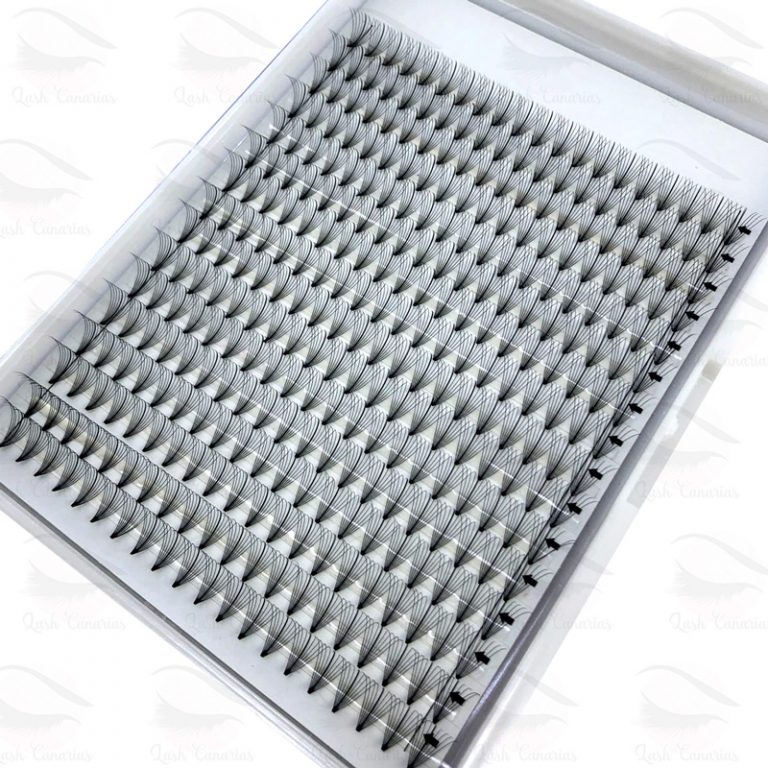
Handmade or premade fans: premade fans come ready-made, with the fibres already bonded at the base. They save time and keep every fan consistent, which is why many techs use them when they’re starting out with volume. Manufacturers admit that a fan made by an experienced artist can have a finer base. You’ll find both options in our lashes category: volume and easy-fan trays for making your own fans, and ready-made premade fans. If you make fans by hand, use volume tweezers with an L-shaped or angled tip.
3. Hybrid lashes
What it is: a mix of classic singles and volume fans on the same eye. It adds texture and sits between classic and full volume.
- Extensions per lash: 1 on some lashes and small fans (around 2D–4D) on others. The ratio varies by source: 50/50, or 30–50% classic to 50–70% fans. None of these is a standard, so adapt the ratio to each design.
- Typical diameters: 0.05–0.07 mm for the fans. Choose the singles to suit the natural lash, as you would for classic.
- Best for: clients who want more than classic but less than full volume, or who are moving from one technique to the other.
- Application time: roughly 2–3 hours.
YY lashes and similar clusters joined at the base give a textured, wispy finish. You apply them almost the same way as a classic extension: pick the cluster up by its narrow base and bond it to one isolated natural lash. That makes them a handy way to add texture to a hybrid set. They usually come in 0.05 or 0.07 mm.
4. Mega volume
What it is: the densest option. Fans with many very fine fibres create a very dark, defined lash line. Some sources also call this “Russian volume”, so it’s clearer to talk in D counts with clients and other techs.
- Extensions per lash: each source gives a different figure: 6–15, 10–16 or more, or 10–20 fibres. What they agree on is that mega volume starts where standard volume ends, at roughly 6D–10D.
- Typical diameters: 0.03 mm, with some sources also allowing 0.05 mm.
- Best for: clients who want maximum drama, have strong natural lashes and will keep up with infills. Guides warn that it can damage fine or weak natural lashes.
- Application time: 3–4 hours or more. This is an advanced technique.
Comparison table
| Technique | Extensions per lash | Typical diameter | Look | Approx. time | Typical infill |
|---|---|---|---|---|---|
| Classic | 1 | 0.10–0.15 mm | Natural, mascara-like | 1.5–2.5 h | Every 2–4 weeks |
| Hybrid | 1 + 2D–4D fans | Fans 0.05–0.07 mm | Textured, in-between | 2–3 h | Every 2–4 weeks |
| Russian volume | 2–6 (up to 8–10 in some sources) | 0.03–0.07 mm | Full and fluffy | 2.5–3.5 h | Every 2–3 weeks |
| Mega volume | From ~6–10 up to 16–20 | 0.03 mm (sometimes 0.05) | Maximum density | 3–4 h+ | Every 2–3 weeks |
Times and infill intervals are the ranges given in industry guides. Every tech and every client works at their own pace.
How long they last and when to infill
No technique lasts forever, because the extension falls out with its natural lash. Here’s what the sources say:
- Without infills, extensions shed gradually, and most of the set has turned over within roughly 4–8 weeks. Sources disagree here: some say 4–6 weeks, others 6–8.
- Infills are generally recommended every 2–3 weeks. One guide allows 3–4 weeks for classic and hybrid and keeps 2–3 weeks for volume and mega volume.
- Volume and mega volume sets look full for longer as lashes shed, because each fan covers more of the lash line.
- Retention depends more on prep, adhesive and primers, technique and aftercare than on the style itself.
How to choose the right technique
- Assess the natural lashes first. Check how many there are, how thick and strong they are, and which way they grow. For weak or brittle lashes, guides recommend fine classic or light volume, and never mega volume.
- Ask what look the client wants. Natural for every day: classic or a soft hybrid. Lots of density: volume. Maximum impact: mega volume, but only if the natural lashes can take it.
- Think about upkeep. Heavier sets need more frequent infills and brushing every day.
- Adjust diameter and length. Go finer before you add more fibres. Longer lengths put more leverage on the natural lash.
Common mistakes when choosing a technique
- Putting thick classics on fine lashes because “classic is gentler”. A 0.15–0.20 mm fibre can weigh more than a light fan.
- Mixing up names. Selling or booking “Russian volume” without a D count leads to misunderstandings.
- Wide fan bases, or fans bonded to more than one lash. These stick lashes together, feel uncomfortable and damage the natural lash. Watch out for stacked fans and too much adhesive.
- Jumping to mega volume without volume experience. It’s an advanced technique that takes a lot of precision with the tweezers.
- Skipping the consultation. A 2019 review of eyelid cosmetic procedures (Masud et al.) links lash extension adhesives, which are mostly cyanoacrylate-based, to cases of contact dermatitis, allergic blepharitis and keratoconjunctivitis. It also recommends that the procedure be done by trained professionals.
Safety: for new clients, or anyone with sensitive skin or eyes, a patch test is commonly recommended. One industry guide suggests applying about 10–12 extensions to the outer corner at least 24 hours before the appointment, and other sources say to watch for a reaction over 24–48 hours. There’s no single official protocol, and a clear patch test doesn’t guarantee there won’t be a reaction. If intense itching, swelling, pain or redness that doesn’t settle appears after application, remove the extensions and see a healthcare professional.
Lash Canarias supplies mentioned in this guide
- Lashes Classical 20 Row
- Lashes Volume 20 Row
- Premade Fan
- Brazilian Volume YY – 16 Row
- Promade Fans Russian Volume 520 – 600 Fans
FAQs
Which type of eyelash extension looks most natural?
Classic (one-to-one) at a moderate diameter, around 0.10–0.12 mm, with shorter lengths. A soft hybrid or a light 2D volume can also look very natural.
Is Russian volume more damaging than classic?
Not necessarily. Volume fibres are much finer. Damage comes from too much weight or poor technique, such as wide bases, lashes stuck together or excess adhesive. The total weight needs to suit each natural lash.
What’s the difference between Russian volume and mega volume?
Mainly the number of fibres per fan and the diameter. Volume usually runs from 2D to 6D at 0.05–0.07 mm, while mega volume starts at around 6–10D and uses 0.03 mm. Some sources use the two names interchangeably, so talk in D counts.
How often do I need an infill?
Industry guides recommend every 2–3 weeks. Some allow 3–4 weeks for classic and hybrid. It depends on how fast each person sheds and on their aftercare.
Can I start with volume while I’m still learning?
Most techs master isolation and placement with classic first. Premade fans and easy-fan lashes make the move to volume easier, but they’re no substitute for proper training.
Sources
- Jones D. “Enhanced Eyelashes: Prescription and Over-the-Counter Options”. Aesthetic Plastic Surgery, 2010 (PMC)
- Masud M. et al. “Eyelid Cosmetic Enhancements and Their Associated Ocular Adverse Effects”. Med Hypothesis Discov Innov Ophthalmol, 2019 (PMC)
- Lash Affair – Types of Lash Extensions: Classic vs Volume vs Hybrid vs Mega Volume
- Lightheart Lash – Lash Extension Types: Classic, Hybrid, Volume, Mega Volume
- Prolash – Types of Eyelash Extensions Explained
- Salonserve – Eyelash Extension Chart: Curl, Diameter & Lengths Explained
- Primor Blog – Cómo conseguir las pestañas con volumen ruso (Spanish)
- Curacoro – Everything to know about eyelash premade fans
- Varsity (sponsored feature) – What are YY lashes and why are lash artists using them
- Divine Lashes – How to Do a Patch Test for Eyelash Extensions