
Getting eyelash extension thickness and length right is what separates a set that looks great and lasts from one that leaves the natural lashes broken or weakened a few weeks later. Diameter and millimetres aren’t just a styling choice: they decide how much weight each natural lash has to carry. This guide covers what each diameter is for (from 0.03 to 0.20 mm), why a little extra thickness adds far more weight than you’d expect, what industry sources say about maximum length, and how to approach the four core lash maps: natural, doll eye, cat eye and squirrel.
What thickness means (and why it isn’t the same as weight)
Thickness is the diameter of the extension at its base, in millimetres: 0.07, 0.10, 0.15 and so on. The higher the number, the thicker the fibre. Thickness and weight are closely linked but they aren’t the same thing: the final weight also depends on the extension’s length and material, plus the adhesive. Two extensions of the same diameter can weigh differently if one is 9 mm and the other 14 mm.
The principle every professional guide agrees on is simple: a fine or weak natural lash shouldn’t carry heavy extensions, because that makes breakage and early shedding more likely.
Eyelash extension thickness: what each diameter is for
The table below summarises the usual use of each diameter according to the manufacturer and academy guides we checked. Treat it as a starting point, not a fixed rule: your training and your assessment of each client come first.
| Diameter | Technique | Typical use | Bear in mind |
|---|---|---|---|
| 0.03 mm | Mega volume | Large fans (roughly 10D–14D and up) | Very fine: bends easily and needs gentle handling |
| 0.05 mm | Full volume | 5D to 10D fans | A little sturdier than 0.03, still very light |
| 0.07 mm | Light volume | 3D to 6D fans; natural effect | The most versatile volume diameter to start with |
| 0.10 mm | Classic / 2D–3D volume | Classic on short or weak natural lashes | For volume, small fans only: above 3D it gets too heavy |
| 0.12 mm | Classic | Finer natural lashes | Medium diameter, a safe choice for many clients |
| 0.15 mm | Classic | Natural lashes of average thickness | The most widely used classic diameter |
| 0.18 mm | Classic | Strong natural lashes only | The upper limit for many lash artists |
| 0.20 mm | Classic | Sources disagree | One guide allows it on strong, long lashes; another advises against 0.20 and above |
Be cautious with 0.20. Lash Jungle reserves it for clients with strong or long natural lashes, while Divine Lashes says 0.20–0.30 diameters should never be used because they’re always too heavy. If you want a bolder classic look without adding as much weight, a common alternative is flat lashes, which have a flattened base. Lash Jungle says its 0.20 flat lash is around 40% lighter than a standard round classic lash; that’s a manufacturer claim about its own product, so check with the brand you use. You’ll find flat options, alongside classic and volume trays, in our lashes range.
Thickness vs weight: why an extra 0.05 mm matters so much
Put simply, an extension is a cylinder. The volume of a cylinder (and so its weight, if material and length are the same) grows with the square of its diameter. That means weight doesn’t rise in line with the number on the tray, it rises much faster:
- Going from 0.10 to 0.15 mm (50% more diameter) means about 2.25 times the material.
- Going from 0.15 to 0.20 mm means about 1.8 times the material.
- A 4D fan in 0.07 mm contains slightly less material overall than a single 0.15 mm extension of the same length.
It’s a geometric approximation (extensions taper towards the tip and every brand uses its own fibre), but it explains why volume is done with fine diameters and why fans have a ceiling. Divine Lashes publishes a reference chart of the maximum fan size based on the classic diameter a natural lash could carry:
| If the natural lash can carry a classic of… | Max. in 0.03 | Max. in 0.05 | Max. in 0.07 |
|---|---|---|---|
| 0.10 mm | 5D | 3D | 2D |
| 0.12 mm | 7D | 4D | 3D |
| 0.15 mm | 12D | 7D | 4D |
| 0.18 mm | 18D | 10D | 5D |
These are ceilings, not targets: a smaller fan is always fine, a bigger one isn’t. The same source points out that many charts ignore the weight of the adhesive, which is another reason not to push right up to the limit.
Choosing thickness based on the natural lash
Before you think about the look, assess the natural lashes: thickness, length, strength and density, and do it for each eye separately, as they’re often not identical. As a working rule, Divine Lashes suggests keeping the extension within ±0.03 mm of the natural lash’s thickness: too fine and it won’t show, too thick and it overloads the lash.
| Natural lash | Recommended classic | For extra length | Avoid |
|---|---|---|---|
| Fine (approx. 0.10–0.12) | 0.10 | 0.07 | 0.18; 0.15 only in short lengths |
| Healthy (approx. 0.12–0.15) | 0.12–0.15 | 0.10 | 0.18 except in short lengths |
| Strong (over 0.15) | 0.15–0.18 | 0.12 | Anything above 0.18 |
Notice the logic: if you want more length, go down in diameter; if you go up in diameter, shorten the length. Weight and length balance each other out.
Length: how much longer than the natural lash?
There’s no official standard, but professional guides agree on a narrow margin:
- Lash Affair and Divine Lashes: around 2 mm longer than the natural lash it’s attached to.
- Lash Jungle: no more than 3 mm longer than the natural lash.
- Divine Lashes adds that if you’re using a diameter at the top end for that lash, the extension should add 1 mm or less of length.
In short: 2–3 mm longer than the natural lash at most, and closer to 2 mm the finer or weaker the lash. Lash Affair also mentions that for volume it usually stays 1 mm below the limit it would use for classic, and that curl changes perceived length: before adding millimetres, try a stronger curl.
Practical tip: measure the natural lashes in several zones (inner corner, centre and outer corner) before you design. Inner-corner lashes are shorter, so it’s worth keeping short-length trays to hand for that area.
Lash mapping: the four core styles
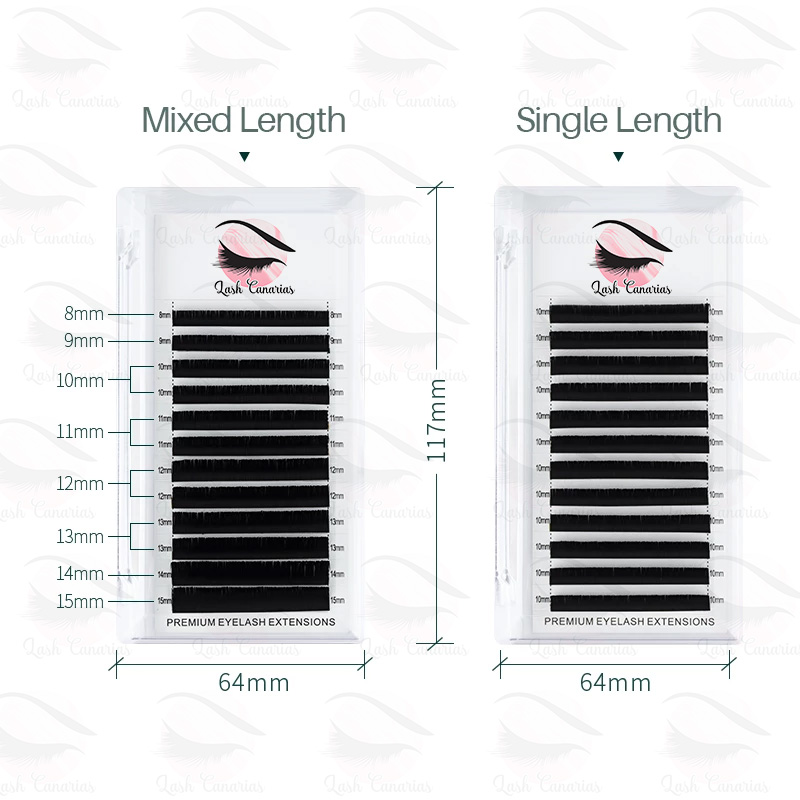
A lash map is the length plan you draw on the under-eye pad before you start (you’ll find gel pads and tapes in Accessories). A common way to build one is to start from the longest length and step down in 1 mm increments towards the corners. These are the four maps almost everyone starts with:
| Style | Where the longest length sits | Example (inner → outer) | Notes |
|---|---|---|---|
| Natural | Centre of the eye, tapering to both corners | 9-10-11-12-12-11-10 | The most versatile; a good choice for first-time clients |
| Doll eye | Centre, above the iris, with more even lengths across the middle | 8-9-10-11-12-11-10 | Opens up and rounds the eye |
| Cat eye | Outer corner | 8-9-10-11-12-13-13 | Lengthens and lifts; Lash Affair advises against it on round or downturned eyes |
| Squirrel | Between the centre and the outer corner | Peak halfway between centre and outer corner, stepping down 1 mm from there | A soft lift without the full elongation of a cat eye |
The natural, doll and cat eye examples are the ones Lash Affair suggests; the squirrel build follows London Lash’s guide. Use them as a starting point and adapt them to each client’s real lashes: a map should never push you past the length rule. On downturned eyes, for example, Lash Affair recommends shortening the outer corner so you don’t exaggerate the downturn.
Common mistakes when choosing thickness and length
- Choosing from the client’s inspiration photo rather than her natural lashes. If her lashes can’t carry it, explain why and offer an adapted version.
- Using one length across the whole eye. Inner-corner lashes are shorter and need less length.
- Increasing thickness and length at the same time. If one goes up, the other comes down.
- Fans that are too big for the chosen diameter, especially in 0.07 or 0.10.
- Attaching one extension to several natural lashes (stickies): Divine Lashes flags this as another source of damage to the natural lash.
- Too much adhesive: it adds weight and can irritate the eyes and skin.
Lash health: knowing when to stop
The American Academy of Ophthalmology (AAO) lists temporary or permanent lash loss among the risks of extensions, and warns that rubbing, tugging or pulling can break natural lashes and damage the follicle. The AAO’s EyeWiki describes traction alopecia: loss of natural lashes caused by the pull of synthetic ones. If a client comes back with gaps, broken or very weak lashes, reduce thickness and length or let the area rest.
If there’s intense itching, redness, swelling or pain after an appointment, the extensions should be removed professionally (never pulled off by the client) and she should see a healthcare professional. The AAO also recommends asking for a spot test of the adhesive on the inside of the wrist beforehand.
If you’re building up your stock, our lashes category has classic, volume, premade fans and special curls, and you’ll find adhesives and primers in Glue & Liquids.
Lash Canarias supplies mentioned in this guide
- Lashes Ellipse Flat 12 Row
- Lashes Double Tips Flat 16 Row
- Lashes Mini Mix 5-8mm
- Lashes Classical 20 Row
- Lashes Volume 20 Row
Frequently asked questions
What eyelash extension thickness is best to start with?
For classic, 0.15 mm is the most widely used diameter on natural lashes of average thickness, and 0.10–0.12 mm on fine lashes. For volume, 0.07 mm with small fans (2D–3D) is a comfortable base. What really decides it is each client’s natural lashes.
How much longer than the natural lash can an extension be?
The guides we checked put the maximum at around 2 mm (Lash Affair, Divine Lashes) or 3 mm (Lash Jungle) longer than the natural lash. With fine lashes or higher diameters, stay at the lower end of that range.
Do 0.20 mm extensions damage lashes?
There’s no consensus: one guide allows them only on strong, long natural lashes, and another advises against 0.20 and above altogether. If you want more impact, consider flat lashes or a 0.15 with a stronger curl.
Which lash map suits almost everyone?
The natural map, with the longest length in the centre, is the one Lash Affair considers most universally flattering and recommends for first-time clients. The squirrel map is also described as suiting most clients.
Does a volume fan weigh more than a classic extension?
It depends on the diameter and the number of fibres. A 4D fan in 0.07 mm has roughly the same amount of material as a 0.15 mm classic of the same length; a 6D in 0.07 is clearly heavier. That’s why large fans are made with 0.03 or 0.05.
Sources
- Lash Jungle – Eyelash Extension Diameters: A Complete Guide
- Divine Lashes – Lash Extension Thickness: How to Choose, Chart & Calculator
- Lash Affair – Tips for Choosing the Right Lash Extension Length
- Lash Jungle – Tips: how to choose the correct length of premade fans
- Lash Affair – Lash Mapping: How to Design Lash Extensions for Every Eye Shape
- London Lash – How to Create Squirrel Eyelash Extensions
- American Academy of Ophthalmology – Eyelash Extension Facts and Safety
- EyeWiki (AAO) – Eyelash Extensions