
J, B, C, CC, D, DD, L, L+, M. Lash extension curls are the letters printed on every tray, and choosing the right one decides whether a set opens up the eye or drags it down. The curl changes the finished look, how the eye reads from the front and in profile, and how well the extension stays on. This guide covers what each curl does, which one suits each natural lash direction and eye shape, and the mistakes to avoid.
Worth knowing: the whole industry uses these letters, but they aren’t standardised. One brand’s C can look more like another brand’s CC. Always compare trays side-on, and test a new supplier’s lashes before you use them on a client.
How to read a curl
Curls fall into two families:
- Round curls (J, B, C, CC, D, DD/U): the fibre curves continuously from the base. They run from least to most curled: J is almost straight and DD/U is the curliest.
- Specialty or flat-base curls (L, L+, M and variants such as LC): the extension has a straight section at the base, then bends upwards. This lifts straight or downward lashes without over-curling the tip.
A useful rule of thumb: the more curled the extension, the less of it touches the natural lash. Professional guides note that a soft B curl has a large contact area, which helps retention. A D curl has little contact area and tends to tangle as the natural lash grows out.
What each lash extension curl does
J: almost straight
A barely-there bend that looks very close to a natural lash. Some brands call it A. It’s very subtle and is often used for natural sets or male clients. Note: sources disagree on where it works. One recommends it for straight or downward lashes, while another warns that on straight or downward lashes it gives a heavy-lidded look. The safest use is on lashes that already grow upwards.
B: soft and natural
A gentle curve with a bit more shape than J, and the closest match to a natural lash’s curve. It suits lashes that already point upwards, as well as deep-set or prominent eyes. It’s also used in the outer corners for a softer finish. Its large contact area makes it a good choice for clients who struggle with retention.
C: the all-rounder
C is the most popular curl. It lifts and opens the eye without looking extreme, and it’s often compared to the result of a lash curler. It works on almost every eye shape, and it helps lift slightly downward lashes or open up smaller eyes. If you’re unsure, start with C.
CC: between C and D
Curlier than C and a little less than D. One manufacturer puts it at about 65°. It opens up the eye on straight or slightly downward lashes and is often suggested for clients who wear glasses. With some brands, CC and D are almost the same.
D: dramatic
A strong curl, about 70° according to the same manufacturer, that creates the classic “doll eye” look. It’s recommended for straight or downward lashes, for small eyes you want to open up, and for glasses wearers. It rarely suits lashes that already grow upwards, because it over-curls them. With so little contact area, keep an eye on retention.
DD (or U): the curliest
This is the tightest curl. Some brands call it U, while others treat U as a separate, even tighter curl. The tip can end up facing the eyelid, so lashes look very curly but not especially long. It’s used on very downward lashes and for bold looks. It isn’t recommended for lashes that already grow upwards.
L: flat base, big lift
L has a straight section at the base, then a sharp bend upwards. It gives a lot of lift without an exaggerated curl and creates a clean cat-eye look. Sources recommend it for hooded lids, monolids, straight lashes, deep-set eyes and lids that droop with age. The flat base sits well on straight lashes, which helps retention. Avoid it on lashes that grow downwards: the flat base can look heavy or too understated.
L+: L with a bit more curl
L+ keeps the lift of an L and adds some curl at the tip. It’s also recommended for hooded lids and monolids when you want a slightly curlier finish. Like L, it’s often mixed with other curls in the same set.
M: lift from close to the root
M is similar to L, but the straight base is shorter, so the extension lifts earlier. It’s mainly recommended for downward or straight lashes and for glasses wearers. Avoid it on lashes that already point upwards. Sources disagree about hooded lids: one article recommends it alongside L, another advises against it. Sources also disagree on which is more intense: some describe M as the more extreme curl, others say L is stronger. It depends on the brand, so compare trays side-on.
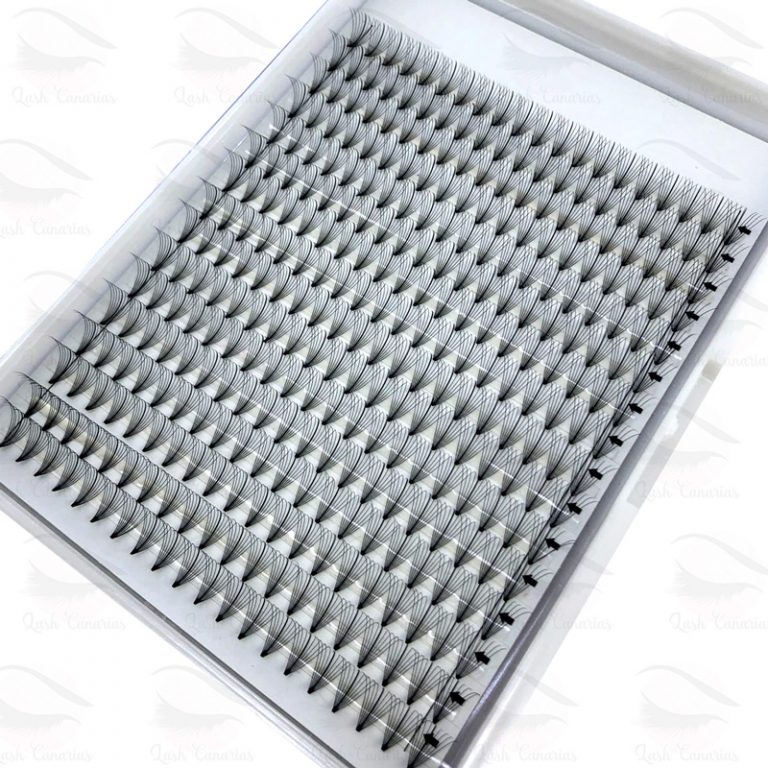
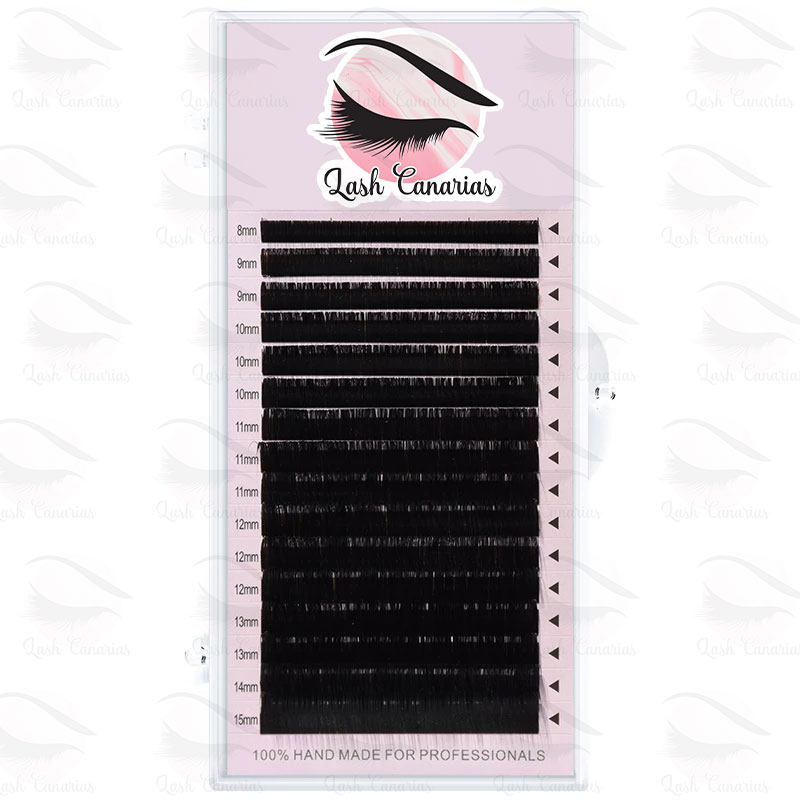
At Lash Canarias you’ll find the specialty L, L+ and M curls, along with classic and volume trays in the standard curls, in our lashes category. Check each product page for the curls available.
Quick reference table
| Curl | Look | Works well for | Avoid on |
|---|---|---|---|
| J | Almost straight, very natural | Lashes that already grow upwards; subtle sets | Straight or downward lashes (heavy-lidded look) |
| B | Soft, natural curve | Upward lashes; deep-set or prominent eyes; retention issues | Clients wanting a lot of lift |
| C | Medium lift, opens the eye | Most eyes; a safe starting point | — |
| CC | Between C and D (~65° per one brand) | Straight or slightly downward lashes; glasses | Strongly upward lashes |
| D | Very curly (~70° per one brand) | Straight or downward lashes; small eyes; glasses | Upward lashes; deep-set eyes |
| DD / U | The curliest | Very downward lashes; doll-eye look | Upward lashes |
| L | Flat base, strong lift | Hooded lids, monolids, straight lashes, deep-set eyes | Downward-growing lashes |
| L+ | Like L, with more curl | Hooded lids and monolids | Downward-growing lashes |
| M | Short base, lifts from near the root | Downward or straight lashes; glasses | Upward lashes (sources disagree on hooded lids) |
Choosing a curl, step by step
- Check the natural lash direction in profile. If the lashes point up, use soft curls (B, C). If they’re straight, try C, CC or L/M. If they point down, try CC, D, M or, in extreme cases, DD/U. Guides stress that lash direction matters as much as eye shape.
- Look at the lid. On hooded lids and monolids, flat-base curls (L, L+) lift the lashes without the tip disappearing into the lid. On deep-set eyes, a strong curl can touch the brow bone.
- Ask about glasses. A curl that’s too straight can brush the lens when the client blinks. CC, D or M usually avoid this.
- Think about retention. More curl means less contact area. If a client sheds extensions easily, consider a softer curl.
- Mix curls where it helps. It’s common to combine curls to tailor a set, for example L with other curls, or B in the outer corners.
Common curl mistakes
- Using D or DD on lashes that already point up. The result looks over-curled and unnatural.
- Strong curls on deep-set eyes. The tips can touch the brow bone.
- Tight curls on hooded lids. One guide warns that with CC or D the tips curl so far up that they almost blend into the lid. It looks artificial and can even be uncomfortable for the client. L, L+ or M usually work better here.
- Using L on downward-growing lashes. The flat base follows the downward angle and the result looks heavy.
- Using J on straight or downward lashes. It closes the eye and gives a heavy-lidded look.
- Trusting the letter alone. Every brand has its own curve. When you switch suppliers, compare side-on before you work.
- Making up for it with length. If a curl doesn’t give enough lift, a longer extension won’t fix it. Longer lengths put more leverage on the natural lash and make retention worse.
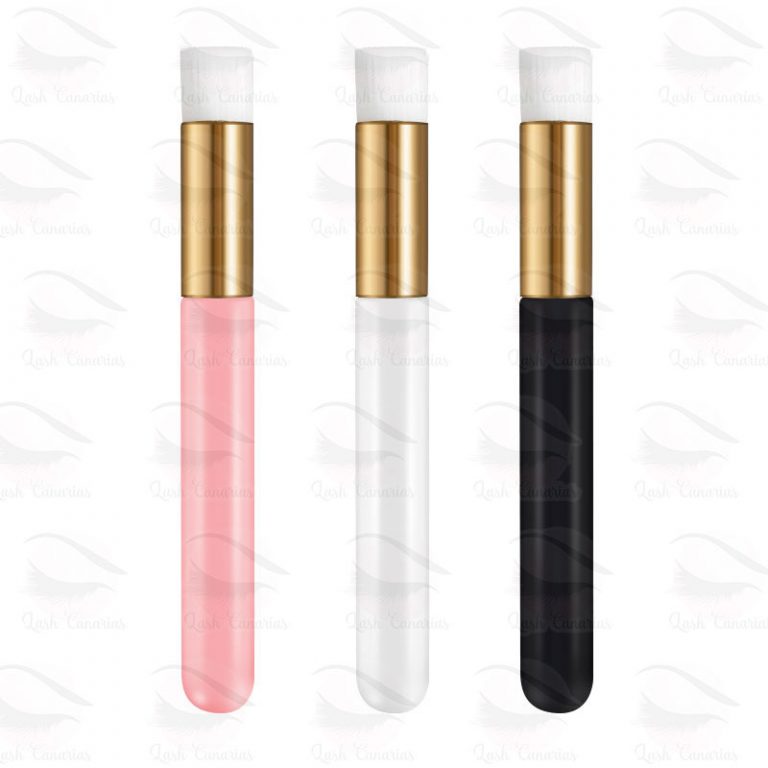
What if the client doesn’t want extensions? If she just wants to lift her own straight lashes, a lash lift is an alternative. You’ll find the kits in our lamination category, along with accessories for the treatment room. With any treatment, if intense itching, swelling or pain appears, remove the product and see a healthcare professional.
Lash Canarias supplies mentioned in this guide
FAQs
Which lash extension curl looks most natural?
B is the closest match to a natural lash’s curve. J is even straighter, but it only looks right on lashes that already grow upwards.
Which curl is best for hooded eyes?
Most of the sources we checked recommend flat-base curls, especially L and L+, and one also suggests M. They lift the lashes above the crease without the tips hitting the lid. Some guides suggest D for hooded eyes, but others warn that CC and D curl so much that the tips get lost against the lid. Start with a flat base.
What’s the difference between L, L+ and M?
All three lift thanks to a straight base. L has a long base and a sharp bend. L+ adds a little more curl at the tip. M has a shorter base and lifts earlier, which is why it’s mainly recommended for downward lashes. The exact intensity varies by brand.
Are CC and D the same?
It depends on the manufacturer. CC generally sits between C and D, but with some brands the difference is minimal.
Does the curl affect how long extensions last?
Yes. The more curled the extension, the less of it touches the natural lash. Guides link soft curls with better retention, and very curly ones such as D with less contact and more tangling as the lash grows.
Sources
- Divine Lashes – Eyelash Extension Curls Explained [Ultimate Guide]
- Curacoro – Eyelash extension curl: the full story
- Curacoro – The guide to M Curl and L Curl
- Curacoro – The best eyelash extension for hooded eyes
- Lash Tavern Education – Curls For All Girls
- Salonserve – Eyelash Extension Chart: Curl, Diameter & Lengths Explained